Chapter 03
The phone picks up.
A site without a phone is a brochure. The AI receptionist is what turns each landing page into a lead. Twilio routes the call. ElevenLabs answers it. The dispatcher assigns it.
Voice + dispatch stack
 Twilio
 ElevenLabs
 GPT-4o
 Supabase
 WhatsApp
 Mailgun
 Vercel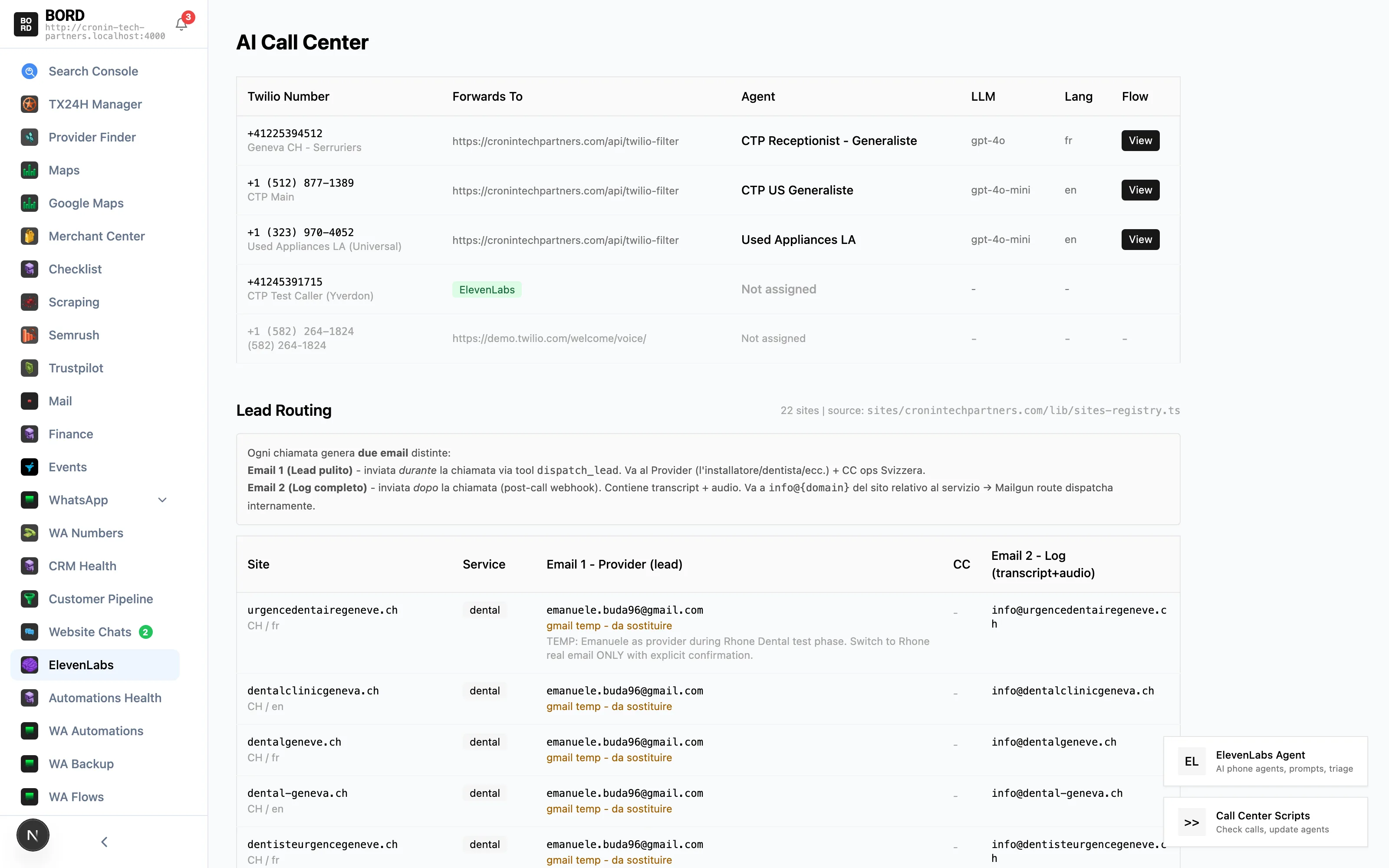
The phone-call architecture
- 01A customer dials the number on the siteEach site has its own Twilio DID (a country-matched number).
- 02Twilio forwards to ElevenLabsInbound webhook fires. ElevenLabs picks up in under 3 seconds (intentional initial_wait_time = 3s).
- 03ElevenLabs runs the agentEric voice on Swiss .ch sites. gpt-4o (not mini — it lost dispatch_lead too often). Agent prompt has the full FAQ and the dispatch logic baked in.
- 04Agent calls dispatch_lead toolStores the lead in Supabase, then routes it to one provider in the right service category and city.
- 05Provider gets a WhatsApp + email + SMSAll three at once. They confirm, they go to the customer.
The dispatch logic
Every lead is matched to a service category and a city. The dispatcher looks at the live provider roster (built in chapter 04), filters by location and capacity, and assigns the lead to one. Not many — one. Multi-dispatch destroys the relationship: providers stop trusting the channel.
One lead, one provider. The relationship is the asset. Diluting it kills the moat.
The dispatcher also enforces country rules: never make outbound calls to a different country than the source. A Swiss customer never gets dispatched to a Bali provider, even if the verticals match.
Quality control
A Vercel cron runs every 15 minutes (/api/elevenlabs-quality-scan), pulls every recent call transcript, and runs three assertions:
- Did
dispatch_leadget called? - Did the agent ask for date of birth? (Forbidden — privacy concern.)
- Did the agent give a specific clinic address before dispatch? (Forbidden — kills the commission.)
Any call failing those assertions raises a flag and the prompt is patched. Mandatory simulation: any prompt change must pass three scenarios (dental urgency, off-topic caller, plomberie routing) before deploy.
What it costs
Twilio number: ~$1.15/month per DID. ElevenLabs: ~$0.04 per real call. Average call ~3 minutes. So a lead costs roughly four cents to serve. The lead pays out at €100 (Geneva dental) or 10–20% commission on closed work. The unit economic is brutal in bord's favor.
A four-cent input that produces a hundred-euro output, with no human in between, is the entire reason this business is worth doing.